

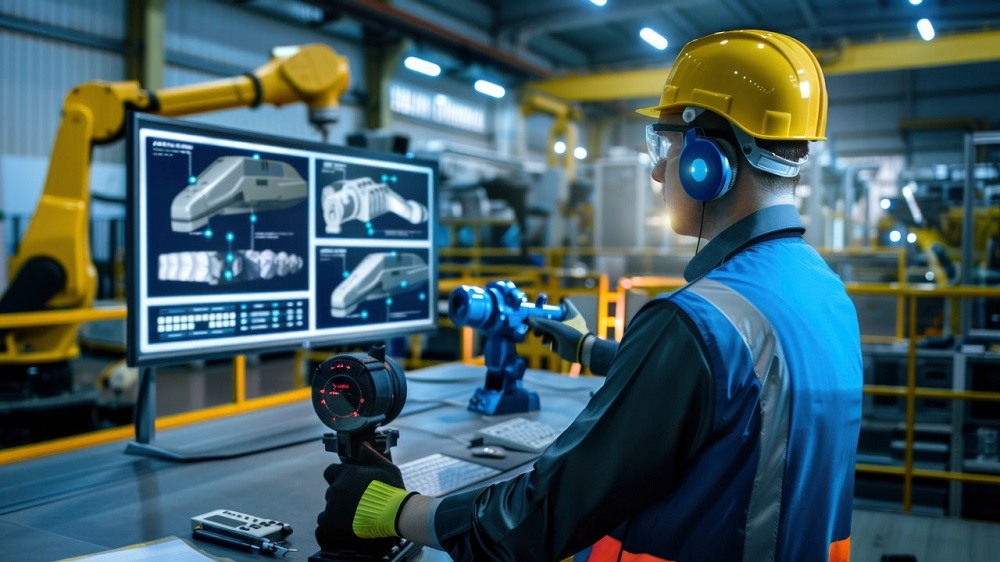
The global manufacturing landscape is undergoing a profound structural transformation. For decades, industrial production relied on manual quality control sampling, rigid automation, and reactive maintenance protocols. These legacy frameworks, while functional, inherently accepted a baseline percentage of material waste, product defects, and operational downtime as the unavoidable cost of doing business.
Today, the integration of advanced digital technologies into manufacturing ecosystems has completely rewritten these operational assumptions. The widespread adoption of smart factory infrastructure allows industrial facilities to move from a state of reactive troubleshooting to proactive optimization. By leveraging interconnected data systems, automated inspection mechanisms, and intelligent analytics platforms, modern enterprises are driving product defect rates down toward absolute zero while simultaneously increasing output efficiency.
1. Real-Time Quality Control via Advanced Computer Vision
Traditional quality assurance protocols historically depended on human inspectors visually auditing products at the conclusion of an assembly line. This approach introduces human fatigue, subjective variation, and a critical operational delay. If a calibration error occurs at the beginning of a production run, thousands of defective units might be manufactured before the flaw is discovered.
High-Speed Optical Inspection and Deep Learning
Modern industrial production lines integrate high-definition computer vision systems equipped with specialized deep learning algorithms. These smart cameras capture high-resolution imagery of components moving at high velocities across conveyor systems.
-
Sub-Millimeter Defect Detection: Computer vision systems scan for micro-fissures, surface blemishes, dimensional deviations, and structural inconsistencies that are entirely invisible to the naked human eye.
-
Instantaneous Sorting and Rejection: When the underlying software detects a variation from the digital design blueprint, the system triggers an automated mechanical arm or pneumatic gate to instantly remove the non-compliant item from the line, preventing the waste of downstream processing resources.
2. Predictive Maintenance Through Internet of Things Sensor Networks
Production quality is deeply intertwined with machine health. When industrial equipment components, such as bearings, shafts, or cutting tools, experience physical wear, their operational tolerances shift. This subtle degradation introduces mechanical vibrations and thermal fluctuations that directly degrade the precision and quality of the finished product.
Deploying Industrial Internet of Things Architectures
By embedding specialized acoustic, thermal, and vibration sensors directly onto critical production assets, manufacturers establish a continuous data stream reflecting machinery health. These Industrial Internet of Things networks transmit real-time telemetry to centralized processing hubs.
Transitioning from Fixed Schedules to Predictive Modeling
Rather than pausing production for arbitrary, scheduled maintenance windows, or waiting for a catastrophic component breakdown, factory managers utilize predictive maintenance models. Machine learning algorithms analyze historical telemetry data to identify precise mathematical anomalies that precede hardware degradation. Maintenance teams are alerted to service specific components hours or days before the wear begins impacting product dimensions or surface finish quality, ensuring the production line operates under ideal mechanical conditions.
3. Digital Twins and Virtual Process Optimization
Optimizing a complex chemical process, automotive assembly line, or metallurgical casting operation requires balancing dozens of interdependent variables, including ambient humidity, raw material purity, processing temperature, and cycle duration. Altering these parameters on a live production floor to improve quality carries immense financial risk and can lead to expensive batch failures.
Creating High-Fidelity Cyber-Physical Replicas
A digital twin is a dynamic, real-time virtual simulation that mirrors the exact physical state, operational behavior, and environmental conditions of a live production asset or entire factory floor. Data collected from edge devices continuously updates the digital model, ensuring it remains perfectly synced with physical reality.
Running Hypothetical Stress Tests safely
Engineers use these virtual replicas to run complex simulations without interrupting actual operations. By testing how modifications to specific processing parameters affect product structural integrity in a virtual space, engineers identify the optimal operational configuration. Once validated within the digital twin environment, these optimized parameters are deployed to the physical machinery, resulting in immediate, predictable improvements in product uniformity.
4. Automated Robotics and Advanced Collaborative Systems
Human physical variability introduces subtle inconsistencies in tasks requiring repetitive precision, such as welding, torque application, or adhesive dispensing. Minor shifts in human posture or fatigue levels over an eight-hour shift can lead to structural variances that impact the long-term durability of an item.
The Precision of Dedicated Industrial Robotics
Modern articulated robotic arms operate with near-perfect repeatability, often executing spatial movements with tolerances tighter than a fraction of a millimeter. By utilizing automated robotics for high-risk or hyper-repetitive tasks, manufacturers ensure that every weld bead, fastener, and structural adhesive layer is applied with identical force and orientation, drastically reducing product variation.
Integrating Collaborative Robots on Assembly Floors
Where complete automation is impractical due to the need for human cognitive flexibility, factories deploy collaborative robots, often referred to as cobots. These machines are engineered with advanced force-torque sensors and proximity detection arrays, allowing them to work safely alongside human operators without physical safety cages. Cobots handle the heavy lifting, highly precise positioning, or strenuous repetitive tasks, reducing human physical fatigue and keeping total assembly quality stable throughout operational cycles.
5. Traceability Architecture via Blockchain and Unified Data Ledger Systems
Industrial quality is profoundly dependent on the integrity of the incoming supply chain. If a batch of raw aluminum, electronic microcontrollers, or chemical polymers contains hidden impurities, the quality of the final product will be compromised regardless of how advanced the factory internal assembly machinery is.
Establishing End-to-End Component Pedigrees
To combat supply chain opacity, forward-thinking manufacturers utilize cryptographic ledger systems and blockchain architectures to record the journey of raw materials. Every step of the material life cycle, from extraction and refining to transit conditions and factory arrival, is permanently time-stamped on an immutable ledger.
Rapid Root-Cause Analysis during Quality Audits
If a component failure occurs in the field, a unified data ledger allows quality engineers to instantly trace the defective item back to its specific production batch, machine operator, raw material lot, and environmental conditions at the exact minute of creation. This hyper-granular traceability prevents broad, expensive product recalls, allowing firms to surgically isolate and recall only the specific batch affected by a verified variable anomaly.
Frequently Asked Questions
How does the introduction of automated inspection technologies affect the roles of existing human quality assurance personnel?
Automated inspection does not eliminate the need for human quality assurance personnel, but rather shifts their responsibilities from repetitive physical scanning to strategic analysis. Human workers transition into roles as system calibrators, data analysts, and continuous improvement specialists. They focus on interpreting the data trends provided by computer vision and artificial intelligence platforms, investigating root causes for systemic anomalies, and adjusting the baseline algorithmic parameters to keep pace with changing design specifications.
What is edge computing and why is it preferred over cloud computing for real-time manufacturing quality control?
Edge computing refers to the practice of processing data locally on devices situated directly on the factory floor, such as smart cameras or programmable logic controllers, rather than transmitting that data to a distant cloud server. This model is preferred for real-time quality control because it eliminates network latency. When a conveyor line is moving units at high speeds, a rejection decision must occur within milliseconds. Edge computing provides the instantaneous processing required to trigger hardware gates immediately, whereas cloud routing introduces delays that could allow defective items to pass through unhindered.
Can small to mid-sized manufacturing facilities implement smart quality technologies without massive capital investments?
Yes, small and mid-sized manufacturers can adopt modern quality technologies incrementally through modular retrofitting strategies. It is not necessary to build a brand-new facility or completely replace legacy machinery to reap the benefits of technology adoption. Facilities can start by attaching external wireless sensors to critical older machinery to begin basic predictive maintenance tracking, or deploy standalone computer vision workstations at high-risk points in the production cycle. This phased approach allows smaller operations to fund future technical expansions using the immediate cost savings generated by initial optimization efforts.
How do environmental conditions inside a factory impact the calibration and reliability of smart optical inspection systems?
Environmental factors like airborne dust particles, fluctuating ambient lighting, and ambient humidity can significantly interfere with optical inspection reliability if not properly managed. To maintain high accuracy, industrial vision systems are housed in ruggedized, sealed enclosures and utilize specialized, consistent LED lighting setups that override changing sunlight conditions. Furthermore, advanced software algorithms are configured with ambient noise filtering to ensure the system ignores airborne debris and focuses solely on the structural contours of the product being audited.
What is the distinction between automated robotics and collaborative robots regarding factory floor deployment?
Traditional automated industrial robotics are designed for high-speed, high-force operations and must be cordoned off from human workers via physical safety cages or light curtains, as their pre-programmed movements do not adapt to unexpected obstacles. Collaborative robots, or cobots, are engineered from the ground up with sensitive internal pressure sensors and specialized skin padding. This allows them to halt their motion instantly upon touching an external object or person, enabling them to work directly alongside human teams without safety barriers to enhance hybrid workflows.
How do modern data analytics platforms help prevent the issue of data silos across disparate production departments?
Modern industrial data analytics platforms utilize unified data architectures that ingest information from entirely different stages of the enterprise ecosystem, such as raw material procurement logs, machine sensor outputs, and post-sale customer feedback forms. By synthesizing these separate data streams into a single analytical dashboard, the platform breaks down departmental data silos. This holistic view allows quality teams to quickly identify hidden correlations, such as discovering that a specific vendor raw material batch routinely causes higher machine vibration levels during a specific downstream milling process.